
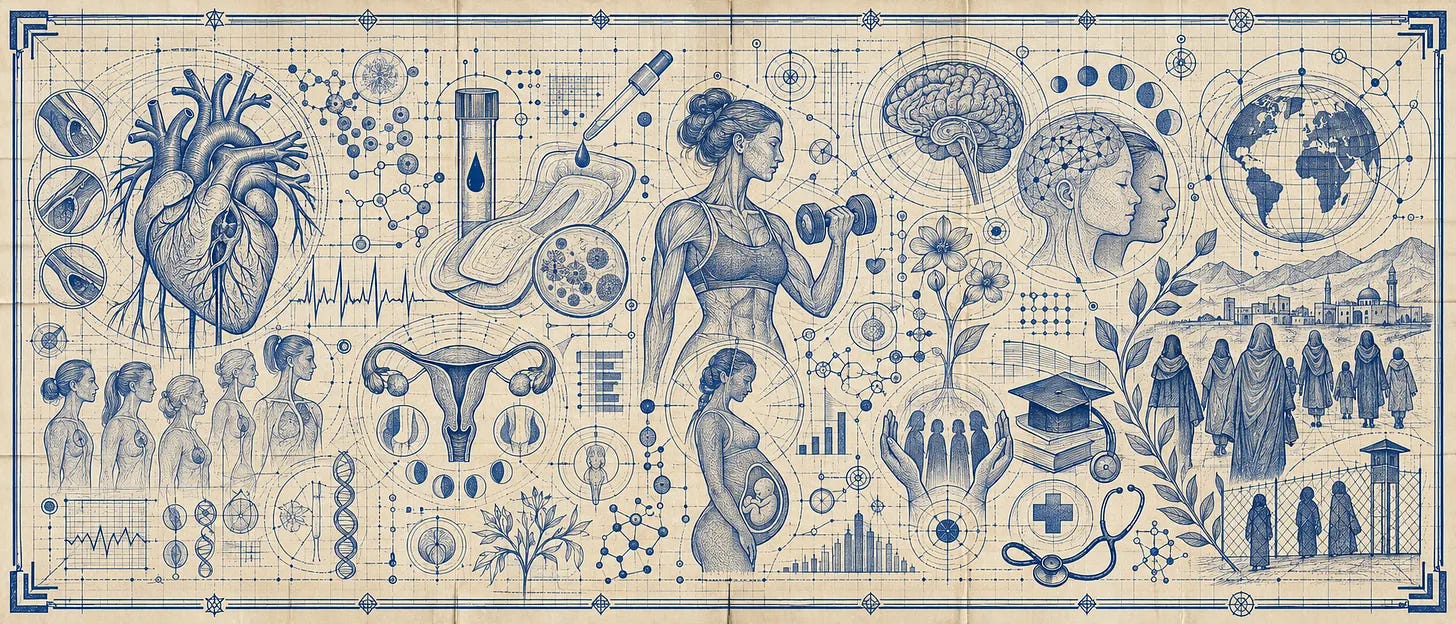
Welcome back to Common Corpus, our weekly curation of the best evidence-based women’s health content designed to help you navigate, optimize, and advocate for your well-being at every stage of life.
This week, good news for women’s health on two fronts: updated guidelines rewrite the definition of a heart attack to address clinical gender biases, and a new study will create the world’s largest biobank of menstrual fluid. We also look at new research on strength training in pregnancy, a podcast on PMS and PMDD and reproductive mental health, and a recent UN report on the dire state of women’s rights and mental health in Afghanistan.
We hope you find this week’s resources insightful, useful, and empowering as you navigate your own health journey. If you’re enjoying Common Corpus and finding it useful, please share it with anyone else who might be interested.
And if you want to learn more about what Common Corpus is, and why we do what we do, please visit our About page.
News & Noteworthy
What’s making the news in women’s health
New global cardiac guidelines aim to improve women’s care
A historic overhaul of global cardiac guidelines re-writes the definition of a heart attack, specifically targeting the diagnostic biases that have often deprived women of life-saving care.
• The new guidelines, endorsed by the world’s four leading cardiovascular organizations, upgrade three less common causes of heart attacks: coronary artery spasm, coronary embolism, and spontaneous coronary artery dissection. These types of heart attacks are up to 10 times more likely to affect women.
• Historically, the most urgent classification of heart attacks prioritized those caused by blood clots. The new criteria formally elevate attacks triggered by factors like emotional stress, extreme cold, or childbirth, which disproportionately impact female patients.
• The updated protocols introduce a lower, sex-specific threshold for measuring troponin, a protein released into the blood during cardiac damage. Because the previous diagnostic threshold was based on a general average, it reliably detected male heart attacks, while consistently missing women, whose natural troponin baselines are lower.
The takeaway: This updated definition is a first step towards overhauling the systematic clinical biases that have historically left female heart attack patients misdiagnosed and under-treated.
New study to create world’s largest biobank of menstrual fluid
A major new UK research project, the CycleTrack study, is creating the world’s largest menstrual fluid biobank to transform how heavy periods and related reproductive conditions are diagnosed and treated.
Led by researchers at the universities of Bristol and Exeter, the study will gather real-time health data and menstrual fluid samples from thousands of women using specially designed period pads.
By combining these fluid samples with daily tracking, questionnaires, and existing longitudinal health and genetic data from established birth cohort studies, researchers aim to identify distinct biological signals linked to heavy bleeding, endometriosis, and fibroids.
Heavy menstrual bleeding affects up to half of women globally, causing debilitating symptoms like severe pain, iron deficiency, and significant disruptions to daily life and educational attainment.
The takeaway: Despite its profound impact on physical well-being and daily life, like much of women’s health, heavy menstrual bleeding has remained chronically under-researched. Building this unprecedented menstrual fluid biobank could pave the way for faster diagnoses, personalized treatment plans, and a much deeper clinical understanding of women’s reproductive health.
The Latest Research
The latest in academic research in women’s health
New research suggests resistance training can be protective against a number of pregnancy complications
A recent systematic review published in the British Journal of Sports Medicine analyzed data from over 47,000 participants to determine how resistance training impacts maternal and fetal health outcomes. Researchers found that pregnant individuals who engaged in strength training experienced 58% lower odds of gestational hypertension, 38% lower odds of gestational diabetes, and 52% lower odds of perinatal mood disorders. The exercise was also associated with a reduced risk (33%) of macrosomia (delivering a significantly larger than average baby, usually defined as 4kg+). While the authors caution that many existing studies combine weightlifting with aerobic workouts, making it difficult to isolate the precise impact of resistance training alone, the overall data points to a clear, protective benefit. So the “don’t lift anything while pregnant” advice does not seem to hold up.
Listen & Learn
The latest in women’s health audio content worth your time
Decoding PMS and PMDD with Dr. Ruta Nonacs
In a recent episode of Decoding Women’s Health, host Dr. Elizabeth Poynor sits down with Harvard Medical School reproductive psychiatrist Dr. Ruta Nonacs to explore the critical, yet historically overlooked, intersection of hormonal shifts and mental well-being. The conversation breaks down the fundamental clinical differences between common premenstrual symptoms (PMS) and premenstrual dysphoric disorder (PMDD), a severe condition that causes debilitating mood swings and anxiety for roughly 3% to 5% of women during their luteal phase. Dr. Nonacs lays out the clinical difference between typical hormonal fluctuations and PMDD, evidence-based treatment options, and advice on when to seek specialized care.
The Global Perspective
Women’s health around the world
The world’s most severe women’s rights emergency
A recent UN report reveals that over half of Afghan women now leave their homes no more than twice a month, forced into extreme isolation by escalating Taliban restrictions on their fundamental freedoms. This severe curtailment of movement and public life is precipitating a profound mental health crisis, with 70% of surveyed women describing their psychological well-being as “bad” or “very bad”. The Taliban’s enforcement of more than 100 discriminatory decrees has systematically dismantled legal equality for women, stripping them of access to education, independent healthcare, and safe public participation. Furthermore, as international aid dwindles, essential women-led support organizations face imminent closure, threatening to abandon Afghan women without critical services during what the UN describes as the world’s most severe women’s rights emergency.
Common Interest
Quick hits that we found interesting, thought-provoking, or useful this week
“It’s [feminism is] about making life more fair for women everywhere. It’s not about a piece of the existing pie; there are too many of us for that. It’s about baking a new pie.” Trailblazing feminist campaigner Gloria Steinem passed away at the age of 92 this past week. LINK
Breast-cancer survivor and global cancer advocate Gloria Chinyere Okwu is working to de-stigmatize breast cancer and breast cancer treatment and the shame and secrecy that surrounds it in Nigeria. LINK
September is gynecologic cancer awareness month. Do you know which cancers they are and symptoms to know? LINK