
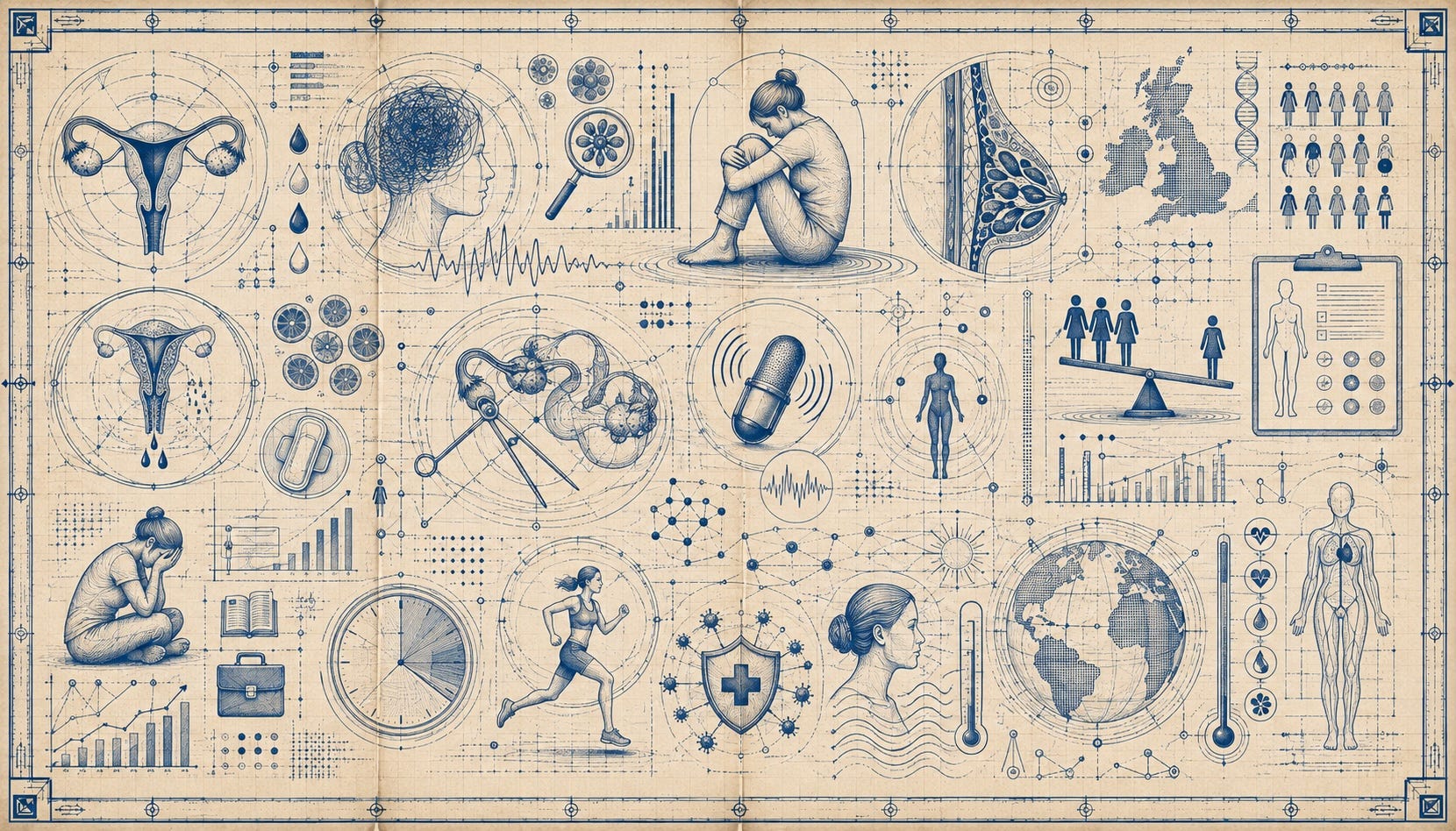
Welcome back to Common Corpus, our weekly curation of the best evidence-based women’s health content designed to help you navigate, optimize, and advocate for your well-being at every stage of life.
This week, we look at the real toll that heavy menstrual bleeding takes on women, physically, psychologically, and economically, why guidelines for breast cancer referrals are missing early detection for women under 50, innovative research exploring the brain-gut connection in recovery from anorexia, why heat waves hit women harder than men, and a fascinating podcast on women’s strength.
We hope you find this week’s resources insightful, useful, and empowering as you navigate your own health journey. If you’re enjoying Common Corpus and finding it useful, please share it with anyone else who might be interested.
And if you want to learn more about what Common Corpus is, and why we do what we do, please visit our About page.
News & Noteworthy
What’s making the news in women’s health
The real cost of heavy menstrual bleeding
For decades, heavy menstrual bleeding has been dismissed as a normal, unavoidable burden of womanhood, but there is growing attention to the physical, psychological, and socioeconomic toll.
Despite affecting between 10% and 30% of women of reproductive age, heavy menstrual bleeding is frequently normalized by patients and overlooked by doctors, leaving many to suffer for decades before discovering underlying causes like fibroids, polyps, or endometriosis.
Beyond the immediate pain and disruption, untreated heavy bleeding frequently causes secondary health problems, including severe iron deficiency and anemia, which can lead to dizziness, brain fog, hair loss, and serious complications during pregnancy.
New qualitative research on the lived experience of heavy periods reveals profound mental health impacts, with patients reporting debilitating anxiety, chronic exhaustion, and even suicidal thoughts due to the life-altering severity of their symptoms.
The condition can equally hinder education and professional advancement.
The takeaway: Heavy menstrual bleeding is not just an inconvenience, but a serious medical condition and often a symptom of larger issues that have been underestimated and under-diagnosed. Recognizing and treating this condition as the severe health issue that it is, is key to addressing the life-altering physical, economic, and mental health consequences for millions of women.
Current UK breast cancer referral guidelines missing early detection for most women under 50
New research reveals that current GP guidelines for breast cancer referrals fail to identify up to 95% of young women who will go on to develop the disease.
• Current criteria from the UK’s National Institute for Health and Care Excellence (NICE) rely primarily on family history to determine if a patient under 50 should be referred for specialist risk assessment and screening.
• This approach misses the vast majority of early cases, largely because 73% of women under 50 who develop breast cancer within a decade have no family history of the disease.
• When researchers used an alternative assessment tool, CanRisk, which analyzes genetics, reproductive history, and lifestyle alongside family history, they accurately identified eight times as many at-risk women.
• While medical experts are calling for an urgent review of the NICE guidelines, replacing a simple family-history check with comprehensive multifactorial screening would require a significant increase in time, cost, and healthcare resources.
The takeaway: Relying primarily on family history to assess breast cancer risk in young women risks missing the opportunity to catch early, treatable cases in most women under the age of 50. While implementing a broader screening model that factors in lifestyle and genetics would place a heavier burden on the healthcare system, doing so is critical for improving early intervention and survival rates.
The Latest Research
The latest in academic research in women’s health
Could a vibrating pill help identify the risk of relapse in patients recovering from anorexia?
A recent study published in JAMA Psychiatry used an innovative, ingestible vibrating capsule to evaluate gut-brain communication in patients who had recently restored their weight after suffering from anorexia nervosa. The research found that, compared to healthy individuals, patients recovering from anorexia were significantly less accurate at detecting the capsule's subtle vibrations, demonstrating a persistent tendency to ignore internal stomach signals even after achieving a healthy weight. Crucially, participants whose perception was the most biased toward ignoring these gut sensations were found to be at a much higher risk of clinical relapse during the subsequent six-month follow-up period. These findings highlight that recovery requires more than just physical weight restoration, as underlying neurological disconnects between the brain and body often remain. Ultimately, this technology could provide clinicians with a helpful tool to proactively identify high-risk patients and better tailor post-recovery treatments to prevent potential relapses.
Listen & Learn
The latest in women’s health audio content worth your time
Are women the stronger sex?
This recent episode of the BBC World Service podcast The Conversation challenges the long-held assumption that the female body is inherently weaker than the male body. Host Datshiane Navanayagam sits down with science journalist Starre Vartan, who explores how women actually hold a physical edge in areas ranging from extreme endurance sports to robust immune responses, and Marlo Möller, a professor of molecular biology, who unpacks the genetics behind why women are significantly better at fighting off and surviving infectious diseases like tuberculosis. Together, they dismantle the cultural myth of the "weaker sex" by breaking down the science of female biological resilience, stamina, and disease resistance. Far from being the "weaker sex," they argue that women possess distinct biological and genetic advantages, particularly in immune strength and physical endurance, that have been historically overlooked by a society that measures human strength almost exclusively through a male lens.
The Global Perspective
Women’s health around the world
Why heatwaves impact women more than men
Recent heat waves in Europe and North America have hit many countries hard this summer. And as extreme weather events become increasingly common, experts are warning that heatwaves disproportionately impact women due to distinct biological differences. Women naturally produce less sweat and begin sweating at higher temperatures than men, which limits their ability to quickly shed excess heat. Additionally, natural fluctuations in hormones during the menstrual cycle, pregnancy, and menopause disrupt the brain's temperature regulation, making it significantly harder for women's bodies to cool down. Extreme heat acts as a severe "stress-test" on women's cardiovascular systems, and as climate change intensifies, there is a need for greater public awareness and targeted medical advice to protect women from heat-related illnesses.
Common Interest
Quick hits that we found interesting, thought-provoking, or useful this week
8-year old Georgia asked for pockets in her trousers, and got Sainsbury’s to listen. LINK
The Afghan women’s football team, living in exile, will be allowed to officially represent Afghanistan on the world stage, following a FIFA rule change. LINK
Women in Gaza are finding emotional and psychological support to deal with trauma, displacement, poverty and grief in organized safe spaces amid war. LINK
These two women led the European boycott that led to FIFA abandoning plans to sell off part of the World Cup. LINK
Washington state is considering one of the most extreme trans athlete bans yet. It would require all female athletes from kindergarten through grade 12 to have her sex assigned at birth verified by a doctor through hormonal testing or physical exam. LINK