
Welcome back to Common Corpus, our weekly curation of the best evidence-based women’s health content designed to help you navigate, optimize, and advocate for your well-being at every stage of life.
This week, we explore how immune cells may explain why pain is experienced differently in men and women, whether antihistamines can treat perimenopause and PMDD symptoms, why social connection matters more for longevity than any biohack or supplement, and an innovative program in Colombia that is trying to dismantle traditional gender roles, among much more.
Next week will mark our first quarterly edition where we will recap some of our most interesting reads/listens over the past three months. If you have a couple of minutes to spare, please tell us what you think of Common Corpus, what your favourite topics/content have been, and what you would like to see covered in upcoming editions. Your feedback is invaluable in improving and growing Common Corpus and to helping us make sure the content is useful and interesting for all our readers.
News & Noteworthy
What’s making the news in women’s health
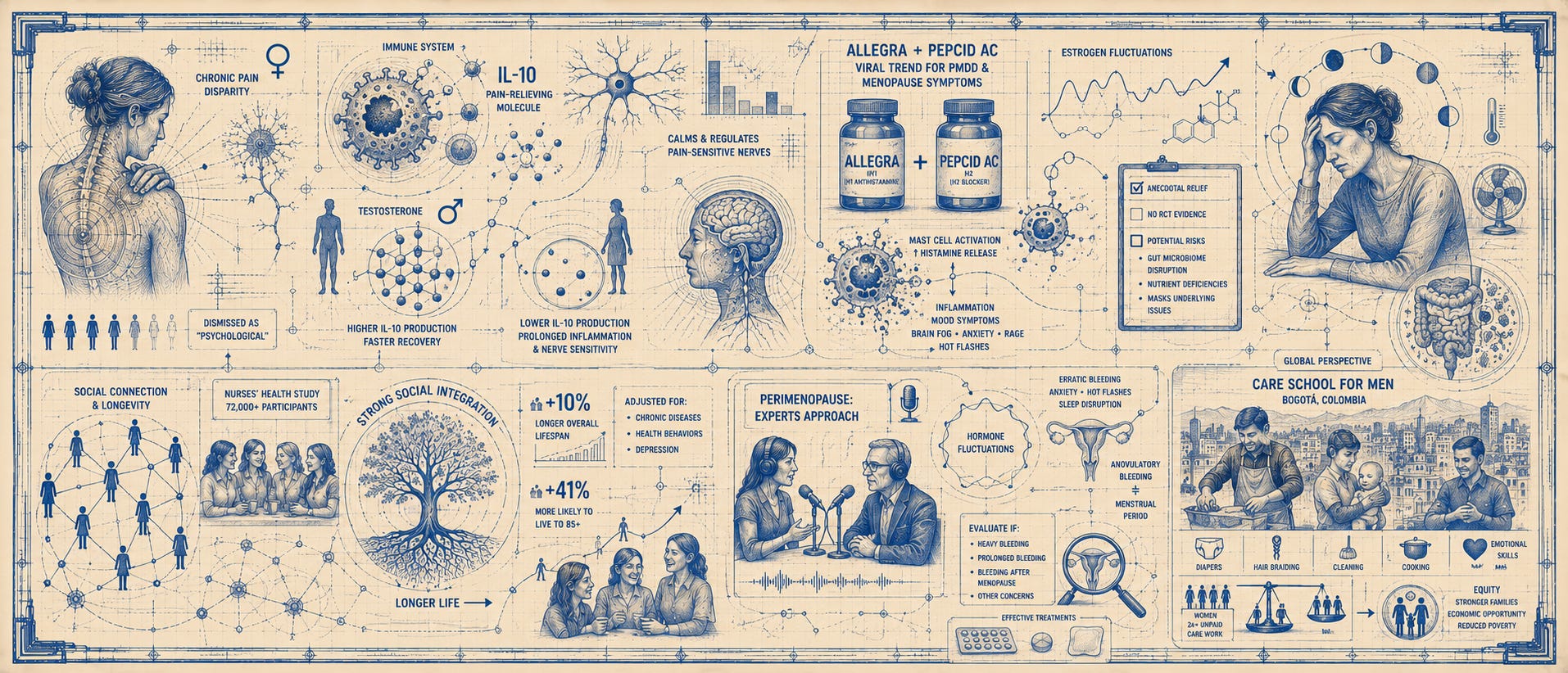
Why does pain last longer for women? Immune cells may hold the answer
New research reveals a clear biological reason why women experience longer-lasting pain: their immune systems produce significantly less of a crucial pain-relieving molecule compared to men.
While women are statistically much more likely to develop chronic pain disorders, their persistent pain has historically been incorrectly dismissed by the medical establishment as merely psychological or emotional.
Scientists have discovered that the immune system plays a central role in this pain disparity, specifically through the production of a molecule called IL-10, which acts to calm and regulate pain-sensitive nerve cells.
Driven by higher testosterone levels, men naturally release much larger quantities of this IL-10 molecule, allowing their bodies to recover from pain and physical injury more efficiently.
Because women produce a lessened IL-10 response, their nervous systems remain inflamed and sensitive for longer periods, leaving them biologically predisposed to prolonged pain.
The takeaway: TLDR: women’s pain is not ‘all in their heads.’
Can Allegra and Pepcid AC really help PMDD?
A viral trend of combining Allegra and Pepcid AC is offering some women unexpected relief from severe premenstrual dysphoric disorder (PMDD) and menopause symptoms, but medical experts are urging caution over unproven long-term use.
Driven by social media, many women are taking a daily combination of an H1 antihistamine (like Allegra) and an H2 blocker (like Pepcid) to combat hormone-related issues such as brain fog, severe anxiety, rage, and hot flashes.
The theory behind the trend is plausible: erratic estrogen levels during the menstrual cycle and perimenopause can trigger mast cells to overproduce histamine, which exacerbates systemic inflammation and mood disruptions.
While anecdotal reports describe the relief as “life-changing,” doctors warn there are currently no randomized controlled clinical trials proving the efficacy or safety of this over-the-counter combination for gynecological or mental health conditions.
Experts caution that long-term, unguided use of these medications could lead to negative side effects like gut microbiome disruption and nutrient deficiencies, or inadvertently mask underlying issues that require targeted hormone therapy.
The takeaway: While the Allegra-Pepcid trend highlights a very real, desperate gap in effective medical care for women suffering from PMDD and perimenopause, the long-term effects are not known, and masking symptoms may mean women do not seek out proper medical evaluation and treatment for these conditions.
The Latest Research
The latest in academic research in women’s health
Does social connection matter more than physical intervention for longevity?
A large-scale, long-term study analyzing data from over 72,000 participants in the Nurses' Health Study found that strong social integration is directly linked to a significantly longer lifespan in midlife women. Researchers found that women with high levels of social connection had a 10% longer overall lifespan and a 41% greater likelihood of surviving to age 85 or older compared to their more isolated peers, even after adjusting for chronic diseases, health behaviours, and depression. This evidence shows how psychosocial assets can be as critical as physical interventions when it comes to healthy aging. These findings underscore the importance of actively prioritizing robust social networks and community support as an essential in thinking about questions of longevity.
Listen & Learn
The latest in women’s health audio content worth your time
Perimenopause problems: an experts approach with Dr. Steven Goldstein
In a highly informative episode of Dr. Streicher’s Inside Information, host Dr. Lauren Streicher and world-renowned menopause expert Dr. Steven Goldstein team up to demystify the notoriously unpredictable phase of perimenopause. A major takeaway from their discussion is that erratic bleeding and intense symptoms like anxiety are heavily driven by chaotic hormone fluctuations, making birth control pills a highly effective treatment to stabilize the body. They also clarify the biological difference between anovulatory bleeding and a true menstrual period, while detailing exactly when irregular bleeding requires a clinical evaluation to rule out issues like fibroids or polyps. This episode aims to provide clarity for women navigating the frustrating uncertainties of midlife, empowering them to understand different approaches to effective symptom relief rather than simply enduring the hormonal rollercoaster.
The Global Perspective
Women’s health around the world
Unlearning machismo: Bogotá’s innovative care school for men
In an inspiring effort to dismantle deeply entrenched gender roles, a unique city-run initiative in Bogotá, Colombia, is explicitly teaching men how to take on their fair share of unpaid domestic labor and child-rearing. Highlighted in CNN’s As Equals series, the “Care School for Men” provides hands-on classes in practical tasks like changing diapers, braiding hair, and cleaning, alongside vital emotional support for anger management and conflict resolution. Women in Bogotá historically perform more than double the unpaid care work of men, a severe household imbalance that restricts women’s access to education, limits their earning potential, and actively drives female poverty. By reframing caregiving as a learned, highly valuable skill rather than a biological female trait, the program challenges Colombia’s traditional “machismo” culture. Participating men are building stronger emotional connections with their children while actively reducing the overwhelming physical and mental load placed on their partners.
Common Interest
Quick hits that we found interesting, thought-provoking, or useful this week
Serena is back and her return to professional tennis at age 44, nearly four years after her last match, marks one of the biggest moments in sport this year. LINK
BBC chief international correspondent Lyse Doucet won the 2026 Women’s Prize for Non-Fiction for The Finest Hotel in Kabul. The book uses Kabul’s Intercontinental Hotel as a frame for modern Afghan history and the lives of people who endured decades of upheaval. LINK
Is period syncing really a thing? Not really, it turns out, but the idea may make menstruation more bearable. LINK
Meet the interstitium: the newly mapped, fluid-filled network hiding inside our bodies that might explain the science behind acupuncture. LINK
Demi Vollering just became only the second woman ever to win all three grand tours in cycling. LINK